The ingredient in Latisse that makes eyelashes grow is bimatoprost, specifically bimatoprost ophthalmic solution at 0. In the FDA prescribing information, Latisse is described as an ophthalmic solution containing bimatoprost 0.3 mg/mL (0.03%) blank" rel="noopener noreferrer">bimatoprost ophthalmic solution at 0.03%. 03% concentration (0.3 mg/mL). That's it. There are no oils, no biotin, no keratin boosters doing the heavy lifting. Bimatoprost is the single active ingredient, and it's a synthetic prostaglandin analogue, meaning it mimics a naturally occurring fatty acid compound that influences how hair follicles behave. Everything else in the formula is inactive carrier ingredients. The growth effect is entirely bimatoprost's doing.
What Is in Latisse That Makes Eyelashes Grow?

Rachel Nguyen
18 May 2026
What bimatoprost actually is

Bimatoprost was originally developed as a glaucoma medication under the brand name Lumigan. Doctors and patients kept noticing an unexpected side effect: people using it had noticeably longer, thicker, darker eyelashes. That wasn't a bug; it became the entire basis for Latisse, which the FDA approved specifically for eyelash growth (hypotrichosis) in 2008. The concentration used in Latisse (0.03%) is the same as in glaucoma eye drops, but the delivery method is different. Instead of being dropped directly into the eye, Latisse is applied with a small applicator brush to the upper eyelid margin at the base of the lashes. Latanoprost, another glaucoma drop, works through a very similar mechanism, which is why questions about latanoprost and lash growth come up frequently alongside Latisse discussions. Latanoprost is another prostaglandin analogue like bimatoprost, so if you're wondering how long it takes for latanoprost to grow eyelashes, the timeline is often discussed in similar terms how long does it take for latanoprost to grow eyelashes. Because latanoprost works through a very similar mechanism, it may also be associated with eyelash growth, even if it is not the same FDA-approved product as Latisse Latanoprost, another glaucoma drop.
How bimatoprost makes lashes grow (the simple biology)
Hair follicles, including eyelash follicles, go through three distinct phases: anagen (active growth), catagen (transition), and telogen (resting/shedding). At any given moment, most of your lashes are in one of these phases, and the duration of the anagen phase largely determines how long your lashes can actually get. This is why some people seem to have naturally long lashes and others don't. It comes down to how long their follicles stay in the growth phase.
Bimatoprost works by interacting with prostaglandin receptors in the hair follicle. The prevailing mechanism, supported by peer-reviewed research published in journals like Dermatologic Surgery, is that bimatoprost extends the anagen (growth) phase of the hair cycle and increases the proportion of follicles that are in active growth at any given time. In practical terms: more follicles are growing simultaneously, and each one stays in the growth phase longer than it normally would. The result is lashes that grow longer before cycling out, appear denser because more are actively growing at once, and become thicker. FDA clinical review data also indicated an increase in the number of eyelash follicles contributing to growth, meaning this is genuine follicle-level activity, not just a surface conditioning effect.
Does Latisse grow new lashes or just improve what you already have?
This is a really important distinction, especially if you're dealing with lash loss from extensions, traction, chemotherapy, or a medical condition. Yes, bimatoprost has been studied for eyelash hypotrichosis, but it is not typically recommended for growing hair on the scalp without medical guidance lash loss from extensions, traction, chemotherapy, or a medical condition. The answer is both, with some nuance. Latisse stimulates existing follicles that may be in a resting or shortened growth phase. If your follicles are dormant but intact, bimatoprost can push them back into active anagen. Clinical trial data on people with eyelash hypotrichosis (including chemotherapy-induced lash loss) showed measurable improvements in global lash assessment scores after four months of use. The FDA's medical review specifically reported findings consistent with increased eyelash follicle activity, not just thickening of existing hairs.
Where it won't help: if a follicle is permanently damaged or scarred (from severe trauma, burns, or certain medical conditions), there's no follicle left to stimulate. Bimatoprost needs a working follicle to act on. For most people dealing with thinning from extensions, stress, or general sparse lashes, the follicles are still there and still viable, which is exactly the scenario where Latisse performs best.
What results to actually expect and when
The FDA-approved treatment period evaluated in clinical studies is 16 weeks (four months) of nightly use. The phase 3 trial (278 adults, randomized, double-masked, vehicle-controlled) used the Global Eyelash Assessment (GEA) scale as the primary endpoint and measured quantitative changes in lash length (in millimeters), thickness, and darkness at the four-month mark. Statistically significant improvements were seen across all three dimensions: length, fullness, and darkness.
Realistically, most people start noticing changes around weeks 8 to 10, with the most visible results appearing at or after the 16-week mark. If you’re using Lumigan for lash growth, plan for similar timelines, since results usually build over the first couple of months most people start noticing changes around weeks 8 to 10. Don't expect dramatic changes in the first month. The biology is working on a cycle that takes time. If you stop using Latisse after achieving your results, lashes will gradually return to their baseline appearance over several weeks to months, because the follicles cycle back to their natural pattern without the prostaglandin stimulus.
| Timeframe | What's typically happening |
|---|---|
| Weeks 1-4 | Bimatoprost beginning to influence follicle cycle; no visible change yet for most users |
| Weeks 5-8 | Some users notice lashes look slightly longer or fuller; subtle changes |
| Weeks 9-12 | More noticeable length and density improvements; results becoming visible |
| Week 16 (4 months) | Full clinical endpoint; peak measurable improvements in length, thickness, darkness |
| After stopping | Results gradually reverse over several weeks to months as follicles return to baseline |
How to use Latisse correctly
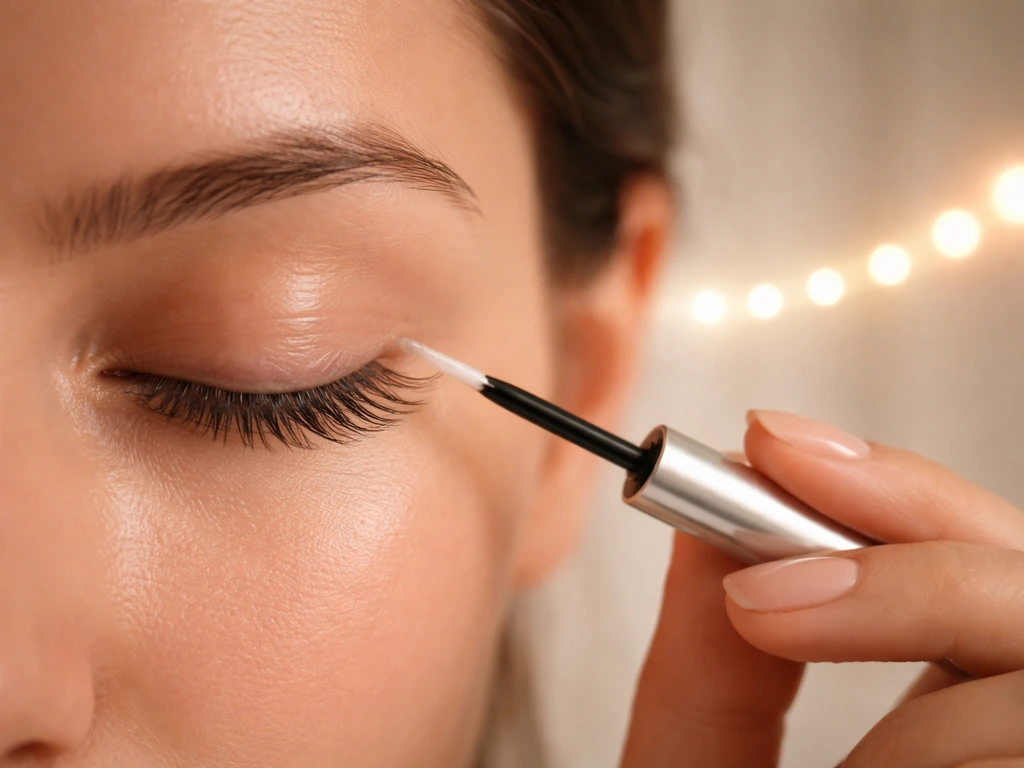
Latisse comes with single-use sterile applicator brushes. Every application uses a fresh one. At night (after removing makeup and contact lenses), place one drop of solution on the applicator, then draw it carefully along the skin of the upper eyelid margin at the base of your lashes, moving from the inner corner to the outer corner. That's the only place it goes. You apply it to the upper lid only, not the lower lash line. If any solution runs onto the cheek or other skin, blot it off. This matters because bimatoprost can cause hair growth and skin darkening wherever it contacts skin consistently.
If you wear contacts, wait 15 minutes after application before reinserting them. One critical note from the prescribing information: using Latisse more than once a day does not produce faster or better results. Once nightly is the clinically studied and approved frequency. More is not more here. Consistency across 16 weeks is what drives results, not doubling up on doses.
- Remove eye makeup and contact lenses before applying
- Place one drop on the sterile applicator brush (one fresh brush per application)
- Draw the applicator along the upper eyelid margin at the base of the lashes only, inner to outer corner
- Blot any excess solution that goes beyond the eyelid immediately
- Dispose of the applicator after use; never reuse or share
- Reinsert contact lenses after 15 minutes
- Apply once nightly, every night, for the full 16 weeks
Side effects, common mistakes, and when to stop
The most commonly reported side effects in clinical labeling are eye itching and eye redness. These are relatively mild for most users but worth knowing about before you start. Other reported reactions include dry eyes, eyelid skin darkening (which is often reversible after stopping), and in some cases periorbital fat atrophy, meaning a subtle hollowing around the eye socket area. That last one is more associated with prolonged or heavy exposure and is one reason precise application technique matters. StatPearls flags periorbital fat changes as a notable safety concern with extended periocular bimatoprost use, and it's worth taking seriously.
Less common but documented postmarketing reactions include eyelid swelling, localized skin reactions, and blurred vision. If you experience sudden vision changes, significant eye pain, or signs of a serious reaction, stop using it and see a doctor. Bimatoprost is an ophthalmic drug and requires a prescription for good reason. It has real pharmacological activity, and it should be used under medical guidance, especially if you have a history of eye conditions, uveitis, or macular edema.
The most common mistake people make is inconsistent application or giving up before 16 weeks. If you skip nights regularly, you're breaking the cycle stimulation that the whole mechanism depends on. Another frequent error is applying to the lower lash line, which is not how Latisse is formulated or approved to be used, and increases the risk of unwanted skin pigmentation changes or excess hair growth in areas you don't want.
How Latisse compares to other lash-growth options
This is where being honest about the evidence matters. Latisse is the only FDA-approved treatment specifically indicated for eyelash growth. Its active ingredient has a well-characterized mechanism, was tested in randomized controlled trials with quantitative endpoints (millimeter changes in lash length, GEA scale scores), and has published peer-reviewed mechanistic research behind it. Nothing else in the lash-growth space has that level of evidence.
| Option | Active ingredient | Evidence level | Mechanism for lash growth | Requires prescription |
|---|---|---|---|---|
| Latisse (bimatoprost 0.03%) | Bimatoprost (prostaglandin analogue) | FDA-approved; phase 3 RCT data | Extends anagen phase, increases follicle activity | Yes |
| Castor oil | Ricinoleic acid (fatty acid) | No clinical trials for lash growth specifically | Unproven; anecdotal conditioning claims only | No |
| Biotin supplements | Biotin (vitamin B7) | Evidence supports deficiency correction only; not proven for non-deficient individuals | No direct follicle-stimulation mechanism established | No |
| OTC lash serums (e.g., RevitaLash, GrandeLASH) | Prostaglandin analogues (cloprostenol ethyl amide, isopropyl cloprostenate) | Cosmetic classification; limited independent trials | Similar prostaglandin pathway but not FDA-approved for growth | No |
Castor oil is popular, and I'm not saying it's useless, but there are genuinely no clinical trials measuring eyelash growth endpoints with castor oil. The evidence that exists is largely anecdotal or comes from blepharitis studies measuring eyelid margin health, which is a different thing than stimulating lash growth. It may help condition and protect existing lashes, but it is not doing what bimatoprost does at the follicle level.
Biotin is a similar story. The NIH Office of Dietary Supplements is pretty clear that biotin supplementation has strong evidence for correcting actual deficiency but does not reliably promote hair growth in people who are not deficient. If your lash thinning is from a biotin deficiency (which is actually uncommon), supplementing makes sense. Otherwise, it's not going to replicate a prostaglandin analogue's follicle-level effects.
Some over-the-counter lash serums like RevitaLash Advanced and GrandeLASH-MD do contain prostaglandin analogues (cloprostenol ethyl amide and isopropyl cloprostenate, respectively), which work through a pathway similar to bimatoprost. These are classified as cosmetics rather than drugs, so they haven't gone through the same regulatory approval process as Latisse, and independent trial data is limited. They're worth knowing about as an option, particularly if accessing a prescription is a barrier, but they're not equivalent to the FDA-approved formulation in terms of documented evidence.
Who Latisse is most likely to help
Latisse was approved for eyelash hypotrichosis, meaning inadequate or sparse eyelashes. That includes people with naturally thin or short lashes, those recovering from lash loss due to chemotherapy, and people dealing with lash thinning from traction damage (heavy extensions, aggressive rubbing). It has also been studied in Japanese subjects with both idiopathic and chemotherapy-induced lash hypotrichosis, with improvements shown at four months in both groups. If your follicles are intact but underperforming, bimatoprost gives them a real, biology-level push. That's the core of what makes it different from anything you can buy off a shelf without a prescription.
FAQ
Can I use Latisse on my lower lashes to get fuller results faster?
If you apply it to the lower lash line or let it spread onto the cheek or under-eye skin, you increase the chance of unwanted eyelid or surrounding-area darkening and extra hair growth where the drug contacts skin. The intended placement is only the upper eyelid margin at the base of the lashes, moving inner corner to outer corner, and blotting any run-off right away.
If one drop nightly works, will using Latisse twice a day grow lashes faster?
Not usually. Latisse is designed to extend the lash growth cycle through the follicles, and the dosing studies used once nightly. Using more often does not speed up the follicle response and raises exposure to the drug, which increases the likelihood of side effects like redness, dryness, or skin darkening around the application area.
What should I do if I get Latisse in my eye?
You should not. Latisse is meant for the upper lash line, and putting it inside the eye or using it as an eye drop increases the risk of irritation. If you accidentally get it in the eye and it burns, flush with sterile saline or clean water and stop further use that night, then contact a clinician if symptoms persist.
Why aren’t I seeing results at 8 to 10 weeks even though I’m using Latisse?
The “more length by 8 to 10 weeks, most visible by 16 weeks” pattern assumes consistent nightly use and correct placement. If you are skipping nights, using it to the wrong line, not using fresh applicators, or applying before fully removing makeup, results often stall or look weaker even if you keep using it for months.
Will Latisse work if my lash follicles are damaged from scarring or burns?
If your lashes fall out due to an issue where follicles are permanently damaged or scarred, Latisse cannot create new follicles. Examples that can limit response include significant burns or trauma and some scarring eyelid conditions. In these cases, a dermatologist or ophthalmologist can help determine whether follicles are still viable.
Can I use Latisse to grow thicker eyebrows?
Latisse is not meant to treat eyebrows. If you apply it to the wrong area, or intentionally apply it to brows without clinician guidance, you could get pigment changes and unwanted hair growth in adjacent skin. If eyebrow growth is the goal, discuss an appropriate option with a medical professional.
Who should avoid Latisse or get extra medical clearance first?
Your prescription should be used for the intended person and as directed. If you have a history of eye inflammation (such as uveitis), macular edema, or other significant eye disease, you may be at higher risk and should get clinician approval before starting. Also, contact a clinician promptly if you develop persistent blurred vision or significant eye pain.
If I stop using Latisse after I reach my goal, will my lashes stay that way?
Yes, stopping usually leads to gradual return toward baseline because the prostaglandin stimulus is removed, so the lash cycle reverts over time. Plan on ongoing nightly use if you want to maintain the result, and expect several weeks to months for changes to fade after discontinuation.
How reversible is eyelid skin darkening from Latisse?
Some users notice eyelid skin darkening, and in many cases it improves after stopping, but timelines vary and it may not fully reverse for everyone. The fastest way to reduce risk is precise application and preventing spillover onto skin, then pausing and getting medical advice if discoloration progresses.
Is it okay to put contacts back in right after applying Latisse?
If you wear contacts, you should wait about 15 minutes after applying before reinserting them, to reduce irritation risk. This is especially relevant on nights when your eyes feel dry or gritty, since prostaglandin analog effects and preservative exposure can worsen discomfort.
When is eye redness or irritation from Latisse considered a reason to stop and get help?
You should see a clinician urgently if you have sudden or worsening vision changes, significant eye pain, or signs of a serious reaction. For mild itchiness or redness, a short pause may help you assess tolerance, but persistent symptoms after stopping mean you should get examined rather than pushing through.
If I switch from an OTC lash serum to Latisse, do I need a washout period?
Over-the-counter serums may contain different prostaglandin analogs, but they are not the same product and may have different concentrations and delivery consistency. If you switch products, treat it like a new regimen, and avoid stacking multiple lash growth products in the same routine because that increases irritation risk without clear added benefit.
What changes can ruin my results if I start Latisse?
Avoid making changes during the first 16 weeks. If you change technique, switch products mid-cycle, or start wearing heavy lash adhesives and extensions aggressively, you can’t reliably tell what’s driving progress. Keep the routine consistent, then reassess after the trial timeframe if you want to adjust anything.
How long does Latisse take to work after lash loss from chemotherapy or traction?
Latisse works best when you still have intact follicles, even if they are in a shorter or resting growth phase. If you recently lost lashes due to chemotherapy or traction-related thinning, response can still be meaningful, but individual variability is high, and timing relative to the underlying cause affects how quickly you notice improvement.
Next Article
Does LUMIFY Eye Drops Make Your Eyelashes Grow?
Find out if LUMIFY or Lumigan can grow lashes, the real ingredient mechanism, risks, and safer growth alternatives